Non-Entangling Biodegradable Fish Aggregating Devices in the Tuna Purse Seine Fishery


Around 60% of global tropical tuna catches are from purse seine sets on drifting Fish Aggregation Devices (dFADs). However, they also are very good at attracting non-target endangered, threatened, and protected species in addition to tuna. Made of non-biodegradable plastic and netting that extends below the surface, dFADs are an entanglement risk to ETP species, especially sea turtles, sharks, and pelagic rays. Given the inherent nature of deploying dFADs in the open ocean, the majority often become lost or abandoned. The fate of approximately 80% of deployed dFADs is unknown. Notably, 7% end up stranded each year.
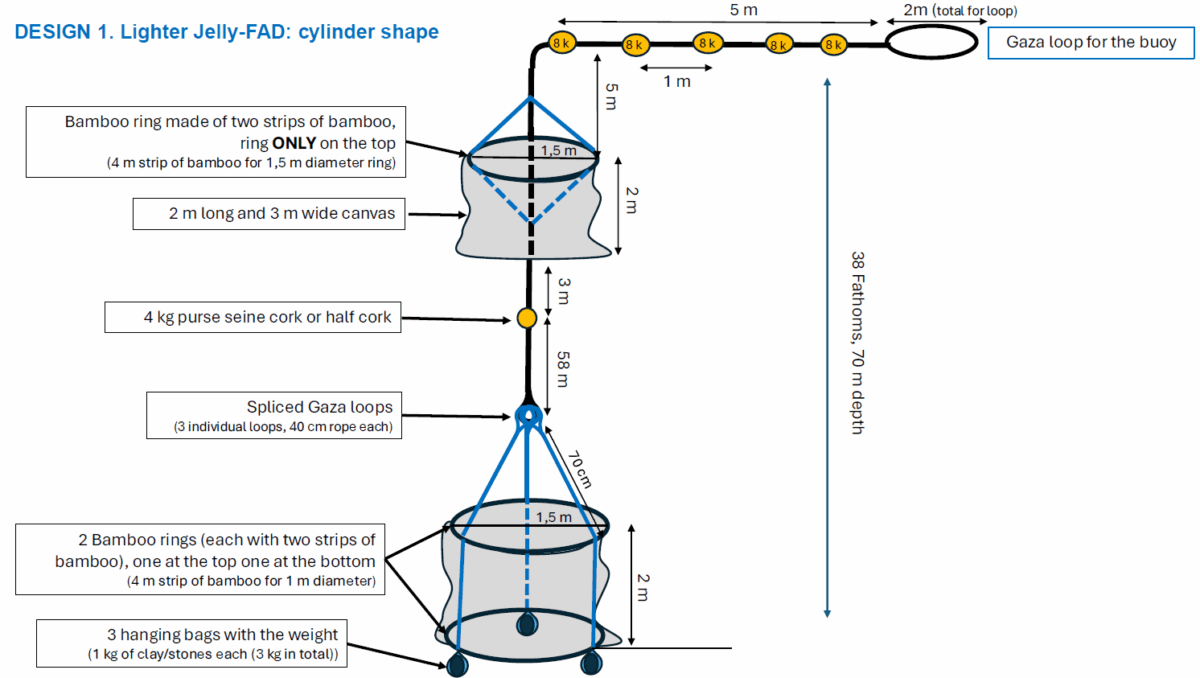
Impacts caused by lost and abandoned dFADs are ghost fishing by the netting used in dFADs that extends below the surface of the ocean, accumulation of plastic at sea, and damage to vital habitats for fish and turtles, including coral reefs. To mitigate these risks, International Seafood Sustainability Foundation (ISSF) scientists have worked with purse seine fleets to develop a biodegradable non-entangling dFAD called the jelly-FAD that eliminates the use of netting in the dFAD structure, biodegrades as fast as possible once their useful lifetime for fishing ends, and minimizes the use of plastic by replacing it with plant-based and other organic materials.
Additionally, through a collaboration with ISSF, the project will provide workshops to participating vessels to develop region-specific jelly FADS. Crews will be trained to construct, deploy, and test the jelly FADs. Jelly-FAD deployments will then be monitored by fishers, who will record data on the performance of the jelly-FADs at sea (e.g., entanglement of ETP species) and provide feedback to ISSF to further improve bio-FAD designs.
UPDATE November 2025:
Project Development Update: The project is underway with bioFADs expected to be deployed in March 2026 to allow for construction, training of the FAD manufacturers and shipment of materials. Once deployed, the bioFADs will be monitored for approximately 8 months and will continue to be monitored after the project ends, as they remain at sea. Preliminary results are expected by summer 2026 (approximately six months after deployment). Information regarding those results will be posted as they become available.
Additionally, fishermen recently contributed their input regarding BioFAD Models to be tested by the US Fleet during a meeting which took place in San Diego, CA, US.
International Biodegradable FAD workshop will take place December 15-16, 2025, at the Aquarium of San Sebastianin in Gipuzkoa, Spain. The event will bring together scientists, fishing industry representatives, NGOs, and management organizations to share experiences and results from ongoing trials and to coordinate future actions toward the wider adoption of fully biodegradable and non-entangling FAD designs. The workshop will include presentations from each fleet to showcase key achievements, challenges, and next steps, updates regarding biodegradable materials, FAD design innovations, research trials and in-depth discussions. A total of 20-25 participants from 13 organizations and 6 different tuna fleets are expected to attend.